


 ??
??
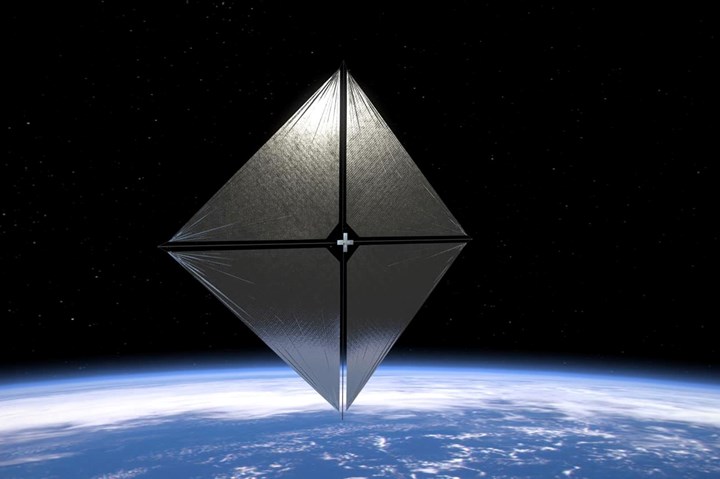
Artist’s concept of the solar sail. Source | NASA/Aero Animation/Ben Schweighart
NASA’s (Washington, D.C., U.S.) mission to test a new way of navigating the solar system is underway. The space agency’s advanced composite solar sail system (ACS3) was launched to space on April 23 (April 24 in New Zealand) aboard a Rocket Lab (Colorado, Colo., U.S.) composites-intensive Electron rocket from the company’s Launch Complex 1 on the Mahia Peninsula of New Zealand.
The ACS3 features booms (which support and connect the sails to spacecraft) that are made from a polymer material that is flexible and reinforced with carbon fiber. The sails use “the pressure of sunlight for propulsion, angling toward or away from the sun so that photons bounce off the reflective sail to push a spacecraft,” according to NASA’s website. This eliminates heavy propulsion systems and could enable longer duration and lower cost missions (learn more about the sail and its development here).Rocket Lab’s Electron rocket deployed the mission’s CubeSat about 600 miles above Earth — more than twice the altitude of the International Space Station (ISS). To test the performance of NASA’s ACS3 system, the spacecraft must be in a high enough orbit for the tiny force of sunlight on the sail — roughly equivalent to the weight of a paperclip resting on your palm — to overcome atmospheric drag and gain altitude.
After a busy initial flight phase, which will last about two months and includes subsystems checkout, the microwave oven-sized CubeSat will deploy its reflective solar sail. The weeks-long test consists of a series of pointing maneuvers to demonstrate orbit raising and lowering, using only the pressure of sunlight acting on the sail.
NASA’s Ames Research Center in California’s Silicon Valley manages the project and designed and built the onboard camera diagnostic system. NASA’s Langley Research Center in Langley, Virginia, designed and built the deployable composite booms and solar sail system. NASA’s Small Spacecraft Technology (SST) program office, within the agency’s Space Technology Mission Directorate (STMD), funds and manages the mission. STMD’s Game Changing Development program developed the deployable composite boom technology. Rocket Lab USA is providing launch services.

 ??Lu public network security: 37140202000173