


 ??
??
CEAD continuously seeks to broaden the portfolio of materials it recommends to customers. KCL’s biocomposite materials — 3D printing granules enhanced with sustainably sourced fibers — have now been successfully tested with CEAD’s hybrid large-format additive manufacturing (LFAM) systems, confirming their compatibility and opening new opportunities for bio-based, circular production.
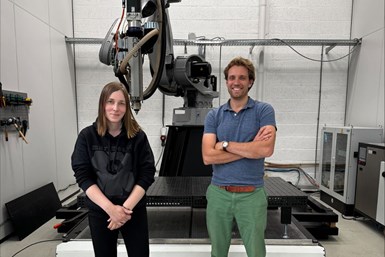
Sources | KCL, CEAD
At the heart of this collaboration is KCL Formi, biocomposites specifically developed for large-format 3D printing. Unlike conventional LFAM materials that rely on carbon or glass fibers, KCL Formi uses patented compositions of fine bleached cellulose pulp fibers in combination with a thermoplastic matrix — delivering both performance and sustainability.
“By replacing traditional reinforcement fibers with cellulose, we’re enabling a new class of materials that are not only strong, durable and easy to postprocess, but are also recyclable and safer to process,” says Eve Saarikoski, development manager at KCL.
The new material innovation offers several key advantages for manufacturers and designers, KCL reports:
Eco-efficiency. No glass or carbon fibers means lower environmental impact during incineration and improved recyclability.
Outdoor durability. Despite being bio-based, the material resists water and outdoor conditions.
Processability. Low shrinkage and fast cooling enable faster, more stable printing.
Postprocessing. KCI Formi is compatible with various coatings, and is easy to mill and sand.
“KCL’s biocomposite materials bring new possibilities to large-format 3D printing, and we believe they can play a valuable role in supporting more circular and responsible production practices,” says Bob Leutscher, sales area manager at CEAD.

 ??Lu public network security: 37140202000173